Mappa Mercia at State of the Map US 2015

posted in: Mapping Party | 1

Last weekend saw hundreds of OpenStreetMappers descend on New York City for State of the Map US 2015. Our very own Andy Mabbett (he’s @pigsonthewing on twitter) was in attendance and gave two talks; the first on Wikidata and it’s inclusion in OpenStreetMap, whilst the second (a 5 minute ‘lightning talk’) was on us, the Mappa Mercia community. Here’s how it played out.

Wikidata for mappers

You can read more about Andy’s proposal to automate wikidata tagging in OpenStreetMap here. To see which map features already include a wikidata tag check out this map.

Mappa Mercia

Andy’s ‘lightning talk’ on day 2 showed off some of our work and discussed how to build a local community:

Voice of Megan Smith

On Saturday a surprise speaker was announced – Megan Smith, Chief Technology Officer of the United States. Andy used the opportunity to capture a sample of her voice for ‘voice intro project‘ he instigated on wikipedia. You can listen to the audio clip on her wikipedia page.
June meetup

posted in: Uncategorized | 0

June 4th saw us meet at the Digby pub in Water Orton after an evening of mapping footpaths, listed buildings, shops, postboxes, addresses and well, just about anything interesting we saw -but not the detective who subjected Matthias to a stop and search , as mapper behaviour of taking notes and photos was regarded as “suspicious”!

What a way for Matthias to end his stay in the UK! Good Luck Matthias back in the Netherlands and thanks for all your hard work with  mappa mercia.

We’ve also decided to setup a Facebook page as a way of reaching a new audience.

OSM UK Quarterly Project No 2 “All things delivery-related”: an update

It’s now May and the project is a month old and with two months to go, it’s time for an update.

Robert Whittaker has an excellent site monitoring OSM data on postboxes in the UK. Here you can see progress (even a league table of who’s contributing). From the history graph you can see there’s been an increase in activity since the project got going. Perhaps Robert might provide some data analysis about the effect of the project.

Enter a postcode and you can find all the missing and incorrect postboxes nearby. I was amazed at just how many were missing in the areas I map regularly: a great incentive to revisit all kinds of places. In doing so I discovered one of those rarities: an EVIIIR royal cypher(OSM node 448635608).

(For non-UK readers King Edward VIII was only on the throne for about 11 months in 1936 before abdicating so there are only about 130 postboxes bearing the royal cypher EVIIIR, these being the ones installed during those 11 months)

How many of these are actually recorded in OSM? It would make a great treasure hunt for the rest of the project. From web research I think there are only 2 in Birmingham so my job’s done.

I’ve been unable to track down some of the indoor postboxes – two in particular are indicated in Sainsbury’s supermarkets near me, but neither exists. This led me to wonder whether Sainsbury’s had some kind of agreement with Royal Mail which didn’t work out so they were removed. But you can’t build a hypothesis on two pieces of data! Does anyone have any knowledge of this? Or replicate my findings?

In the West Midlands we’ve had some fun trying to locate the Coventry ParcelForce depot which is NOT where Google thinks it is. It moved over two years ago and is now mapped in OSM . Thanks must go to our local sleuth: spiffymapper.

Parcel Lockers are poorly mapped – only 8 existed in OSM for the UK at the start of the project. Now there are 11 . It turns out that one of the operators, ByBox, has its national distribution centre in Coventry so time for spiffymapper to get his sleuthing shoes on again!

Any other stories on what folk have been up to on this project are welcome.

New UK Quarterly Project (April-June)

New month, new quarter, new project.

Our first attempt at a quarterly project has just finished, where fixing road names was the target. I’m sure there was an uplift in the rate of clearing these up and a big thank you to everyone who took part, but we don’t have any formal metrics (perhaps ITOworld might do some analysis on comparable rates across quarters) and there’s still a way to go to clear the total number of mis-named roads. What is clear is that there’s not enough mappers on the ground to tackle something basic like this and we don’t have a scalable method for contacting existing and potential mappers.  I guess maintaining a  map isn’t as exciting as creating one! Anyway as we proceed with quarterly projects hopefully we’ll  evolve how to solve both problems.

Our goal with quarterly projects is obviously to improve the map in a co-ordinated way but also to try and develop the UK mapping community by reaching out to new audiences and to re-energise existing and lapsed mappers.

So, on to our next project: all things delivery-related

This could be Royal Mail postboxes (still loads to do); Royal Mail delivery offices and sorting offices; delivery areas/gates to factories and town centre shopping malls; maxheights and maxweights on roads; courier depots; distribution warehouses; new internet shopping parcel lockers (see wiki entry); there’s a new parcel-collection service based around mainline stations called Doddle.it; airfreight facilities; railway marshalling yards; secure lorry parks; port/dock facilities and anything else you can think of. All suggestions and stories welcome.

Dealing with OS Locator road name data: special cases

posted in: Uncategorized | 2

This is a mini-tutorial presented as part of the UK Quarterly Project to fix road names.

There are occasions when along a long stretch of road the name changes several times. In the absence of a survey confirming that the local authority precisely defines where the name changes by placing road name signs adjacent to each other, you need some method of determining where the name changes. If you don’t have a helpful placement of road signs then a change in the house numbers is a good indication.

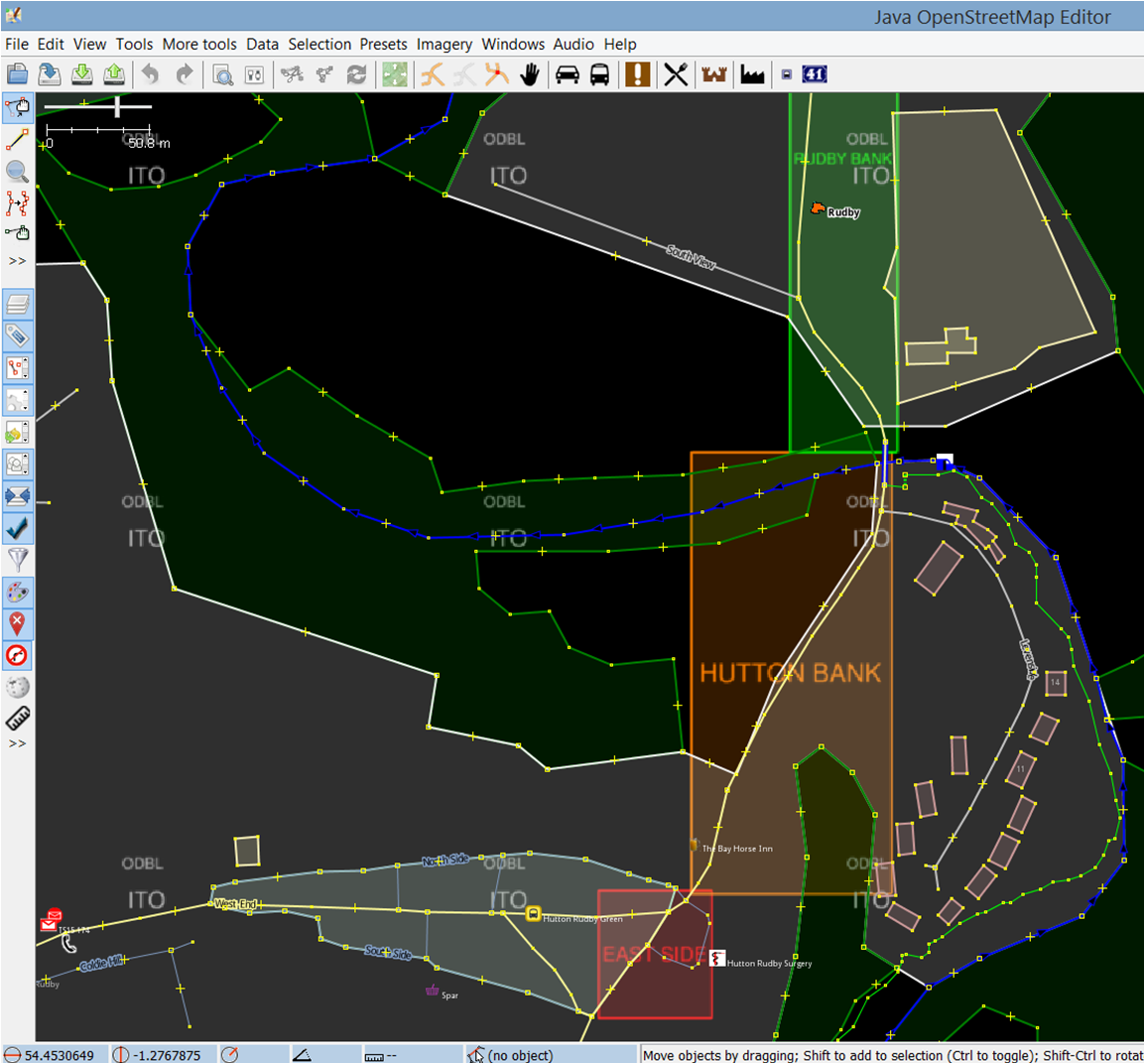
However, armchair mapping  can make use of the OS Locator data layer whilst editing. In the example shown, there is a stretch of road with 3 names. The geometry of the OS Locator blocks is a good indication of where the road name changes.

Long Roads in OS Locator

East Side (at the foot of the image above) shouldn’t be added because it’s already named something else in OSM and needs a ground survey, but it’s likely East Side is correct , given the nearby roads running from it, named South Side and North Side.

Hutton Bank and Rudby Bank can be named as OSM has no name for them. There’s a slight added complication that the road name seems to change in the middle of a bridge. So we can split the bridge and add the names up to where the OS Locator boxes indicate, not forgetting to add the tag source:name= OS_OpenData_Locator.

Result: one small improvement to OSM road name data.

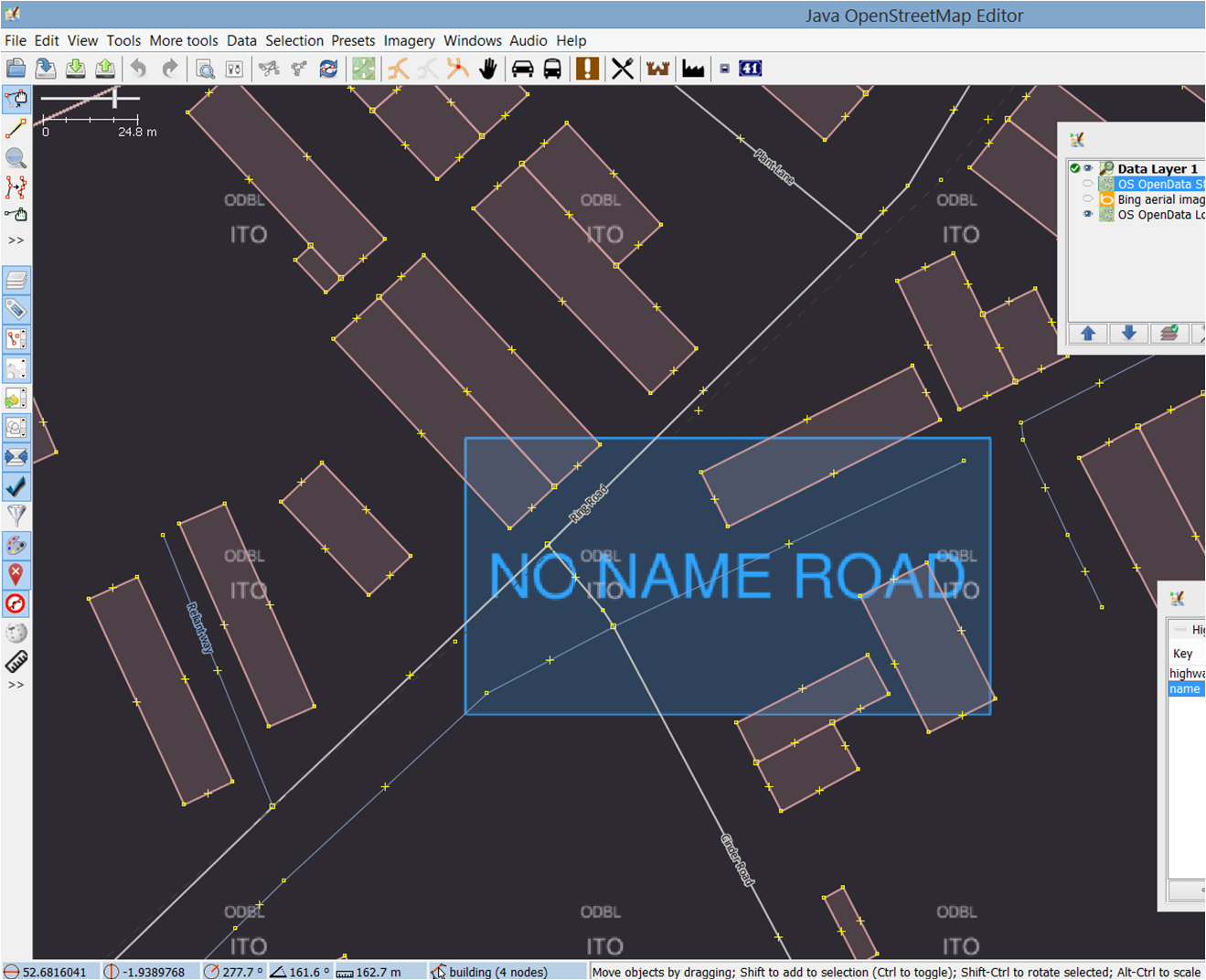
There are occasions when the OS Locator data just throws up something that is unresolvable! Is this OS adding a sense of humour to its data? Were the staff just bored? Or is there really a road with no name called No Name Road? This has to be the special case of all special cases!

No name road

OpenCage Data Open Geo Interview

posted in: Participate | 0

OpenCage  Data have featured us in their long-running Open Geo interview series. You can read the interview here.

OpenCage Data is a division of Lokku. Founded in 2006 and based in London, Lokku are long time supporters of OSM – they’ve sponsored numerous State of the Map conferences, mapping parties, and made major donations to HOT-OSM and OSMF’s server drives. They also run #geomob, a meetup of London location based service devs. Opencage are best known for Nestoria, a  property search engine.

Fix road names with iD editor

posted in: Participate | 2

Have you been following our UK quarterly project to fix road names in OpenStreetMap and been wanting to contribute but don’t know how? If yes, then read on to find out how.

Firstly OpenStreetMap is a volunteer driven project that aims to build a free map of the world. The first 10 years of this project have been extremely successful – our contributors have collected data that is so rich and diverse that OpenStreeetMap now powers map data on hundreds of web sites, mobile apps, and hardware devices. Welcome to our community!

There are two ways to contribute to OpenStreetMap: you can notify the community of something that needs changing, or you can jump in and make the change yourself. Notifying the community is the easiest option but it may take some time for the change to be made. To add a note head over to openstreetmap.org and click “Add a note to the map” (the icon just above the question mark on the right hand side). You will need to drag the pointer to the correct location and type a comment in the text box.

Editing the map data requires a few more steps but the guide below will help you to fix a road name. We will be using the iD map editor but this task can also be accomplished with other map editing software such as Potlatch 2.

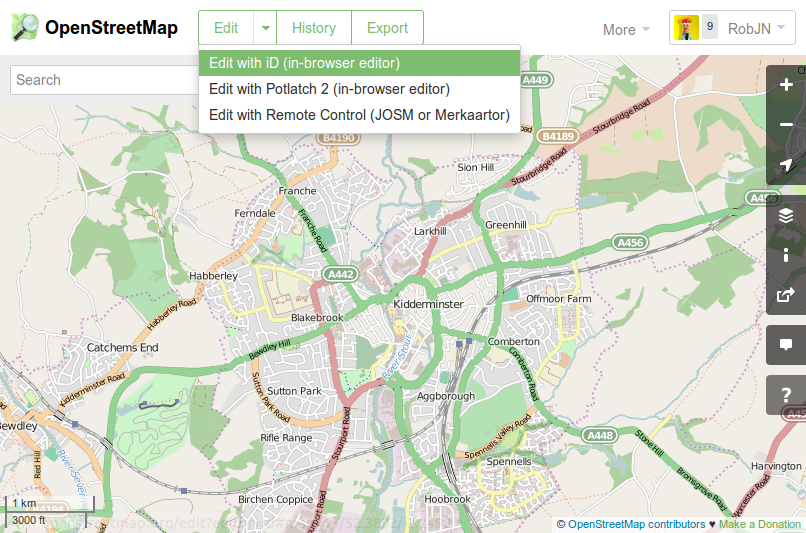
To check for incorrect road names in your local town move the map to the area of interest and click the “Edit” drop down arrow, then “Edit with iD”. This opens the iD map editor. If this is the first time you have used iD you will get a walkthrough guide that shows you how to edit OpenStreetMap. This guide can be restarted at any time by pressing “h” to bring up the help menu and then clicking “Start the Walkthrough”.

Opening the iD map editor

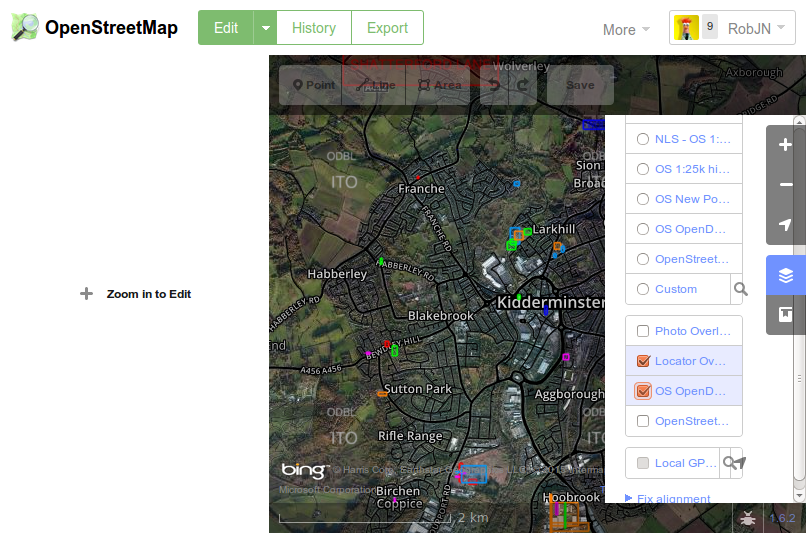
To see which road names need checking in your area click on the background settings icon on the right (or press “b”), then tick “OS OpenData Locator”. This brings up any brightly coloured squares on the map which indicate where the Ordnance Survey has a different road name than that of OpenStreetMap.

Show potential road names that need fixing.

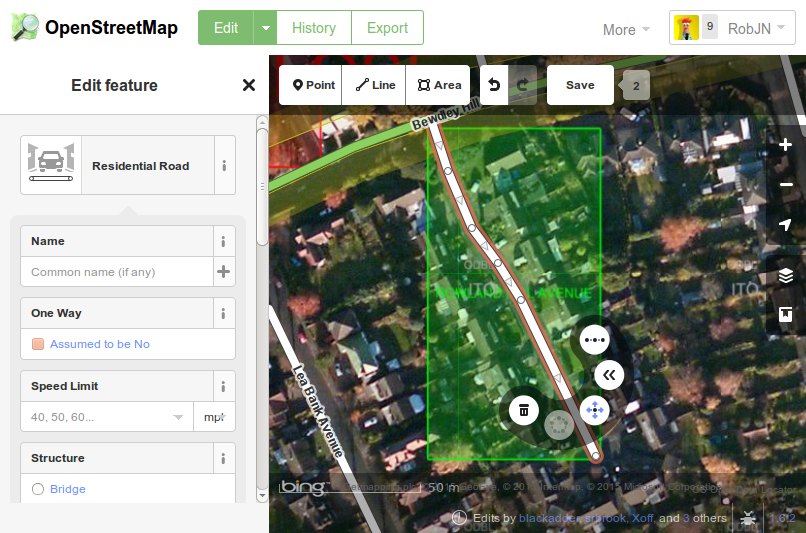
Once you confirmed the correct name (for example, by seeing what the road sign itself says) the you can enter this in OpenStreetMap by clicking on the road and then typing the name into the “Edit Feature” panel that opens on the left. Once finished don’t forget to click “Save”.

Edit the road name.
Edit the road name.

Congratulations, you are now part of a community of mappers that contribute and maintain data about roads, trails, cafés, railway stations, and much more, all over the world.

Data update for UK Quarterly Project: road name fixing

Now that Itoworld have resolved their technical problems we can see if the Road Name Quarterly Project is having an effect. Here are the top 20 local authorities from Itoworld’s OSM Analysis service:

Rank Area
Roads in
OS Locator
Road missing from
OSM
Percentage
Complete
Missing Change
Last Day
Missing Change
Last Week
Missing Change
Last 30 Days
256 Manchester 6,941 152 97.74 0 -46 -46
369 Rochdale 3,666 164 95.44 0 -31 -31
267 South Staffordshire 2,092 47 97.56 0 -17 -18
355 Knowsley 2,268 82 95.72 0 -17 -17
273 Cannock Chase 1,514 36 97.42 0 -16 -16
122 Blaby 1,598 5 99.69 0 -13 -13
139 Bromsgrove 1,693 8 99.53 0 -9 -9
400 South Northamptonshire 1,581 63 94.81 0 -9 -9
214 City Of Nottingham 3,601 42 98.56 0 -8 -8
297 Bedford 2,213 48 96.93 0 -8 -17
105 Bournemouth 1,766 2 99.83 0 -6 -6
321 Lichfield 1,738 54 96.43 0 -6 -11
103 North Wiltshire 2,249 3 99.87 0 -5 -4
159 County Of Herefordshire 2,723 15 99.34 0 -5 -6
340 Daventry 1,625 62 96.06 0 -5 -5
3 South Gloucestershire 3,629 0 100.00 0 -4 -4
113 Ashford 1,893 4 99.79 0 -4 -4
142 Ellesmere Port And Neston 1,395 7 99.50 0 -4 -4
157 West Somerset 914 6 99.34 0 -4 -4
357 Horsham 2,167 81 95.71 0 -4 -4

Thanks to all the mappers who have participated, including those not in the top 20: if you’ve only got a couple of roads left to check you’ll never appear in the top 20 but your contribution is just as valuable.

Congratulations also to those who’ve got their local authority area to the 100% mark recently: Torfaen; Dover; Gwynedd; Powys; West Lothian; Wolverhampton; and South Gloucestershire.

It would be nice to personalise this but I don’t have the necessary skills to identify the users programmatically, or the time to do it manually. Maybe privacy concerns suggest it’s not a good idea but the whole idea behind a quarterly project is to build more community engagement and co-operation so we do need to get to know each other (especially those who aren’t veteran mappers or denizens of mailing lists and chatrooms)

Currently we don’t know whether our quarterly project experiment has incentivised people to go out and tackle this problem or whether it would have happened anyway. Any feedback would be appreciated.

Reaching a new audience in the UK

At our monthly mappa-mercia pub meeting we were chatting about new ways of encouraging participation in the current quarterly project to fix street names. It seems that there are people who both contribute Notes and comment on them who might not be on talk lists nor be aware of the OS Locator data which highlights name problems. So we thought that adding Notes about road names that need fixing on the standard OSM map, asking for confirmation of the correct name might elicit some response via a comment indicating the correct name. This could then be edited by a mapper.

Potentially, by using this method we would address a new audience who are prepared to add data occasionally but don’t want to be hard-core mappers.

This method would work best for situations where OSM and OS Locator have different road names.

We’d like to try this in an area with a high density of road name fixes and few active mappers. Liverpool, Rotherham and Manchester look to be likely candidates (258, 225 and 198 road name fixes respectively). If there are active mappers in these areas who don’t want this to happen please let us know soon and we’ll keep away. You could of course volunteer another area, either for us to pilot or to do it yourself.

If we don’t get a sufficient response to our Notes we would follow up with web searches for local community groups who have twitter or facebook accounts and ask for their participation via those media.

Fix that road name! Progress Report

posted in: Uncategorized | 2

Well done to the folk in:

City of Leicester, Bradford, Darlington, Redcar and Cleveland, Hartlepool, Shetland Islands, Sheffield,  Berwick upon Tweed, Rutland and Guildford

You are our leaders in our first quarterly project.

How about Liverpool, Fife, Rotherham, and Manchester, all with over 200 road name errors, getting up amongst the leaders?

A challenge to anyone with coding skills:

Can we take the data on which ITOworld work, from where  the data shown above comes, to make it personal, so we can see who is doing the editing- similar to the daily “leader board” for Irish townlands?

We have corrected 247 road names in the last week. So if we continue at this rate we should have completed another 2,223 by the end of the quarter. Let’s see if we can build on this and make a bigger dent in the task. Otherwise we’ll still have another year and a half to complete it – and that’s without the OS Locator updates adding more corrections