✨ Christmas Special: Get 35% OFF your first order. ✨
Your bag is empty
![Lab Tested Electroweld Hand Operated Rod Butt Welder 15kva (rbw-15) Instant 85% Discount [WEZRGFg4]](https://cdn.shopify.com/s/files/1/0496/2867/6247/products/RodButtWelder_Data_RBW-15_71fdf06a-e507-4445-b240-128212e1abe6.jpg?v=1626913417)
![Lab Tested Electroweld Hand Operated Rod Butt Welder 15kva (rbw-15) Instant 85% Discount [WEZRGFg4]](https://cdn.shopify.com/s/files/1/0496/2867/6247/products/RodButtWelder-HandOperated-2.png?v=1626913417)
![Lab Tested Electroweld Hand Operated Rod Butt Welder 15kva (rbw-15) Instant 85% Discount [WEZRGFg4]](https://cdn.shopify.com/s/files/1/0496/2867/6247/products/RodButtWelder-HandOperated-3.png?v=1626913417)
![Lab Tested Electroweld Hand Operated Rod Butt Welder 15kva (rbw-15) Instant 85% Discount [WEZRGFg4]](https://cdn.shopify.com/s/files/1/0496/2867/6247/products/RodButtWelder-HandOperated-1.png?v=1626913417)
![Lab Tested Electroweld Hand Operated Rod Butt Welder 15kva (rbw-15) Instant 85% Discount [WEZRGFg4]](https://cdn.shopify.com/s/files/1/0496/2867/6247/products/HandOperatedRodbuttwelder8.jpg?v=1626913417)
![Lab Tested Electroweld Hand Operated Rod Butt Welder 15kva (rbw-15) Instant 85% Discount [WEZRGFg4]](https://cdn.shopify.com/s/files/1/0496/2867/6247/products/HandOperatedRodbuttwelder9-3.png?v=1626913417)
![Lab Tested Electroweld Hand Operated Rod Butt Welder 15kva (rbw-15) Instant 85% Discount [WEZRGFg4]](https://cdn.shopify.com/s/files/1/0496/2867/6247/products/ElectroweldHandOperatedRodButtWelderWeldability-Specs_2da7a521-cd06-47e3-9cdf-fc7f40ac33b4.png?v=1626913417)
![Lab Tested Electroweld Hand Operated Rod Butt Welder 15kva (rbw-15) Instant 85% Discount [WEZRGFg4]](https://cdn.shopify.com/s/files/1/0496/2867/6247/products/BUTTWELDEDONRBW20.jpg?v=1626913417)
![Lab Tested Electroweld Hand Operated Rod Butt Welder 15kva (rbw-15) Instant 85% Discount [WEZRGFg4]](https://cdn.shopify.com/s/files/1/0496/2867/6247/products/BUTTWELDEDONRODBUTTWELDER-RBW20-2_6fbbbc71-85f8-4a6e-8bea-fdb9a6be4c59.png?v=1626913417)
![Lab Tested Electroweld Hand Operated Rod Butt Welder 15kva (rbw-15) Instant 85% Discount [WEZRGFg4]](https://cdn.shopify.com/s/files/1/0496/2867/6247/products/hand-operated-rod-buttwelder-samples.jpg?v=1626913417)
![Lab Tested Electroweld Hand Operated Rod Butt Welder 15kva (rbw-15) Instant 85% Discount [WEZRGFg4]](https://cdn.shopify.com/s/files/1/0496/2867/6247/products/BUTTWELDEDONRODBUTTWELDER-RBW50PN..._b9ea08f9-a036-46c1-8278-c1c27d6dfe77.jpg?v=1626913417)
![Lab Tested Electroweld Hand Operated Rod Butt Welder 15kva (rbw-15) Instant 85% Discount [WEZRGFg4]](https://cdn.shopify.com/s/files/1/0496/2867/6247/products/BUTTWELDEDONRBW20.....jpg?v=1626913417)
![Lab Tested Electroweld Hand Operated Rod Butt Welder 15kva (rbw-15) Instant 85% Discount [WEZRGFg4]](https://cdn.shopify.com/s/files/1/0496/2867/6247/products/hand-operated-rod-buttwelder-samples2.jpg?v=1626913417)
![Lab Tested Electroweld Hand Operated Rod Butt Welder 15kva (rbw-15) Instant 85% Discount [WEZRGFg4]](https://cdn.shopify.com/s/files/1/0496/2867/6247/products/hand-operated-rod-buttwelder-samples3.jpg?v=1626913417)
![Lab Tested Electroweld Hand Operated Rod Butt Welder 15kva (rbw-15) Instant 85% Discount [WEZRGFg4]](https://cdn.shopify.com/s/files/1/0496/2867/6247/products/Optional-Auto-Annealer_dad9b98f-bd85-4b79-b5aa-dd85bf8a1bfb.jpg?v=1626913417)
![Lab Tested Electroweld Hand Operated Rod Butt Welder 15kva (rbw-15) Instant 85% Discount [WEZRGFg4]](https://cdn.shopify.com/s/files/1/0496/2867/6247/products/RobButtWeldingJaws.jpg?v=1626913417)
![Lab Tested Electroweld Hand Operated Rod Butt Welder 15kva (rbw-15) Instant 85% Discount [WEZRGFg4]](https://cdn.shopify.com/s/files/1/0496/2867/6247/products/RBW-OVER_HANGING_JAWS.png?v=1626913417)
Listing Templatebody{margin:0 auto;padding:0;width:100%;font-family:'Poppins',sans-serif}h1,h2,h3,h4,h5,h6{padding:0;margin:0}.tani-background{background:#f8f8f8}.tani-clear{clear:both}img{max-width:100%;}/*Common Css Start*/.tani-wrapcen{width:100%;
100% Safe Guarantee
On orders over $30
30-Day Guarantee

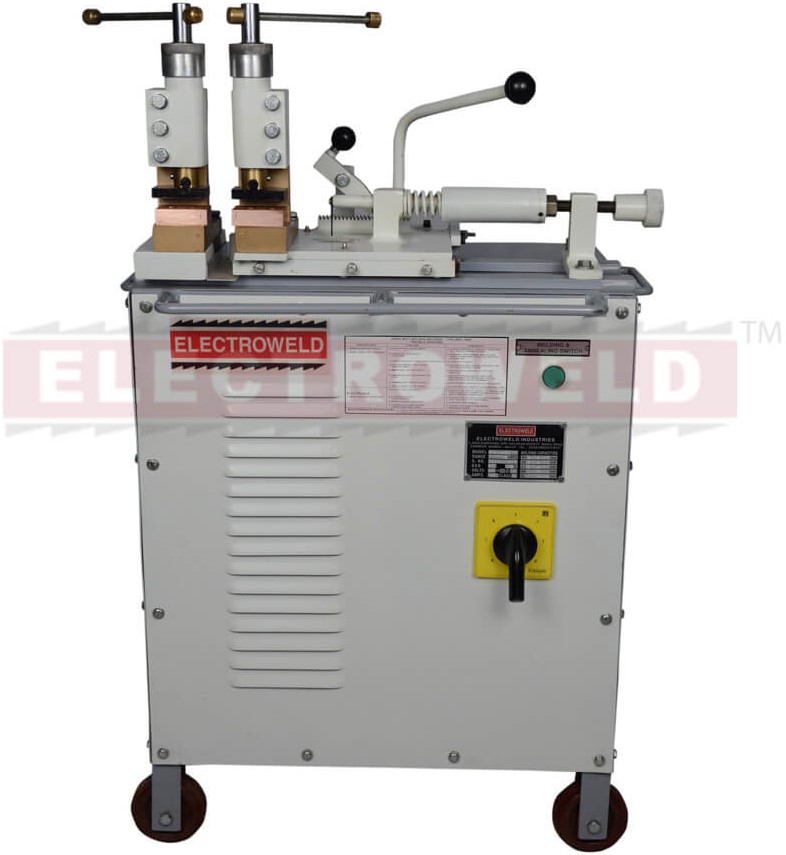
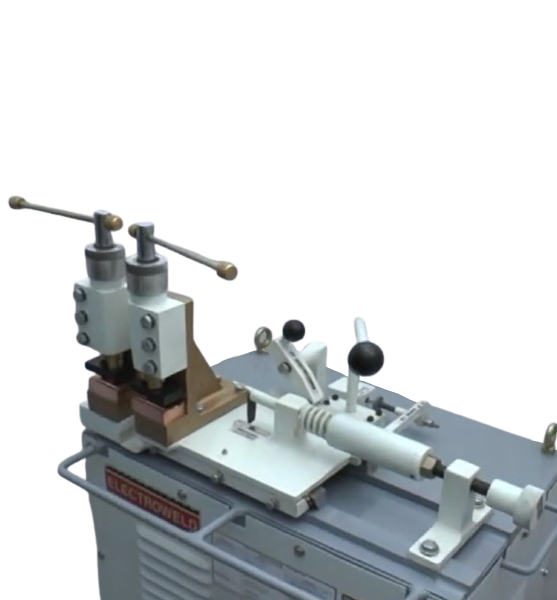
Electroweld Hand Operated Rod Butt Welder 15KVA, Model: RBW-15

Video 1- Electroweld Hand Operated Rod Butt Welder-Operational 1:

Video 2- Electroweld Hand Operated Rod Butt Welder-Operational 2:
Video 3- Electroweld Hand Operated Rod Butt Welder-Operational 3:
Video 4- Electroweld Hand Operated Rod Butt Welder-Operational 4:
Video 5- Electroweld Foot Pedal Operated Rod Butt Welder-Operational 5:
Electroweld industries is a leading manufacturer of resistance welding equipment, serving the industry for over 45 years. Our welding machines are designed to provide a production solution at an affordable price while ensuring reliability and low cost maintenance.
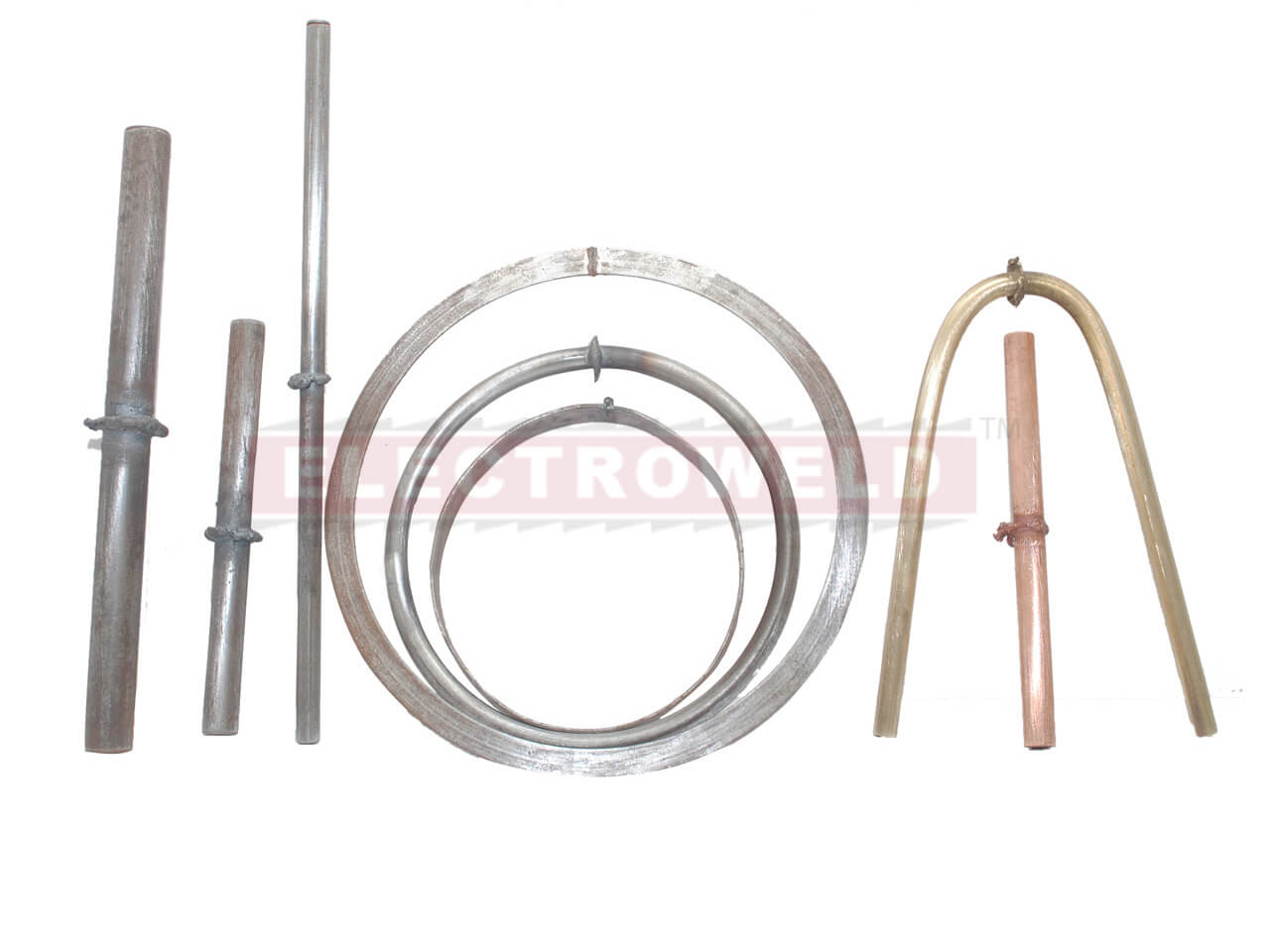
Applications: Upset butt welding of all profiles of wires and flats of iron, steel, alloy and carbon steel, copper, aluminium, brass and other light metals and their alloys. Carbon Steel and Bimetal Blades Butt Welding
Electroweld Hand Operated Rod Butt Welder 15KVA Model: RBW-15
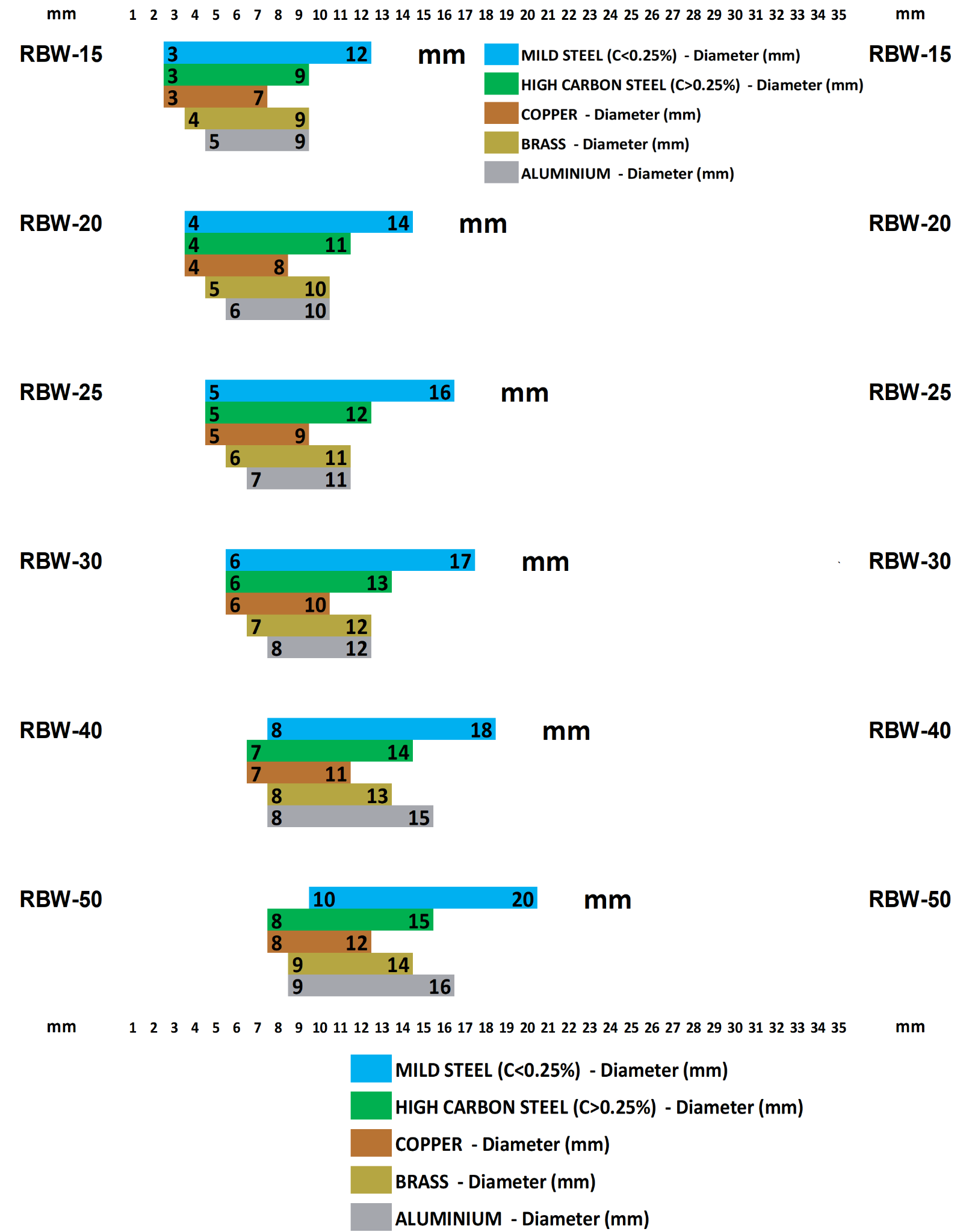
-Weldability - Diameter - Mild Steel: 3mm-12mm, High Carbon Steel: 3mm-9mm, Copper: 3mm-7mm, Brass: 4mm-9mm, Aluminium: 5mm-9mm.
-Weldability - Cross-Sectional Area - Mild Steel: 7-113 mm², High Carbon Steel: 7-64 mm², Copper: 7-38 mm², Brass: 13-64 mm², Aluminium: 20-64 mm².
-Weldability - Welding Range - Mild Steel: 9 - 4/0 AWG, High Carbon Steel: 9 - 2/0 AWG, Copper: 9 - 1 AWG , Brass: 6 - 2/0 AWG, Aluminium: 4 - 2/0 AWG.
Users: Include wire strip and rod drawing mills, transformer motor and switch gear manufacturers, bandsaw and hacksaw blade users, small tool makers for welding mild steel shanks to alloy steel portion of taps, drills, bits, screw drivers, chisels, etc., hoop and ring manufacturers, wire forming industries, cable industries, automobile industries, air-conditioner and refrigerator makers, office equipment makers, etc.
Construction: The machines are constructed with a sturdy light alloy housing and designed as portable models mounted on a moveable stand fitted with four wheels. They are constructed for quick, easy and fool-proof operation, the welding process being automatic. Settings are simple, finely adjustable and reproducible for all variables. Uniform welds of high strength capable of withstanding subsequent drawing ensured.
Simple Settings:
1. ELECTRODE SPACING: Adjust lever on indexing plate.
2. WELDING CURRENT: Operate knob of the 8 step switch, current making and breaking is automatic via a built-in electromagnetic contactor.
3. UPSETTING PRESSURE: Micrometrically adjustable with pressure knob.
4. CURRENT ON / OFF: Micrometrically adjustable with simple thimble.
Welding Process:
1. Fix the above 4 simple settings, clamp the job end-to-end in the centre of the welding jaws.
2. Release gap stopper lever from teeth, press the push button and the welding then takes place automatically. Unclamp Job.
3. To anneal, put spacing lever to max. position. Clamp Job centrally in annealing clamps. Push the welding switch till annealing temperature is reached.
Design Features:
UPSET TRAVEL: Movable platen travel on parallel guides.
UPSET PRESSURE: Provided by a precision spring action on the movable platen and micrometrically adjustable with a knob. Setting is readable on a scale.
CLAMPS: Lever operated adjustable 'floating' steel clamps of precision quick acting design ensure firm preset clamping pressure. Release is quick and easy.
ELECTRODES: Special wear resistant copper alloy electrodes provided with precision 'V' grooves, permit rapid and accurate alignment of wires / blades.
WELDING CURRENT ADJUSTMENT: By means of a 8 step rotary switch from 50% to 100%.
ELECTRODE SPACING: Obtained with ease by a lever set against an indexing plate, adjusting in 10 steps.
WELD CURRENT INITIATION: By pressing welding / annealing push button after clamping the job to weld position simply starts the automatic welding cycle.
CURRENT CUT OFF: Adjustable over a wide range by means of micrometric thimble the setting of which is read on a graduated scale.
ANNEALING FACILITY: Annealing electrodes with screw type clamps provided for ease and quick annealing of the welded job ensuring a flexible zone at both ends of the weld.
PORTABILITY: The machine is mounted on a four wheeled trolley type stand for easy portability.
Electroweld Hand Operated Rod Butt Welder 15KVA Model: RBW-15
Weldability - Mild Steel: 3mm-12mm, High Carbon Steel: 3mm-9mm, Copper: 3mm-7mm, Brass: 4mm-9mm, Aluminium: 5mm-9mm, Carbon Steel Bandsaw Blades (width): 20m-40mm, Bi-Metal BandSaw Blades (width): 5mm-27mm.
* Power Requirement is 220V AC 50/60Hz or 415V AC 50/60Hz(Price includes customization as per requirement before shipping)
**Butt Welders upto 30KVA can operate on either 2 Lines/Phases 220V (+10%/-10%) or 400V (+10%/-10%) 50/60Hz
***Butt Welders greater than 30KVA can only operate on 2 Lines/Phases 400V (+10%/-10%) 50/60Hz
****Additional set of spares and consumables can be quoted to be added to the shipment as required
Specifications Table:
Weldability - Diameter of the Solid Wire or Rod (mm):
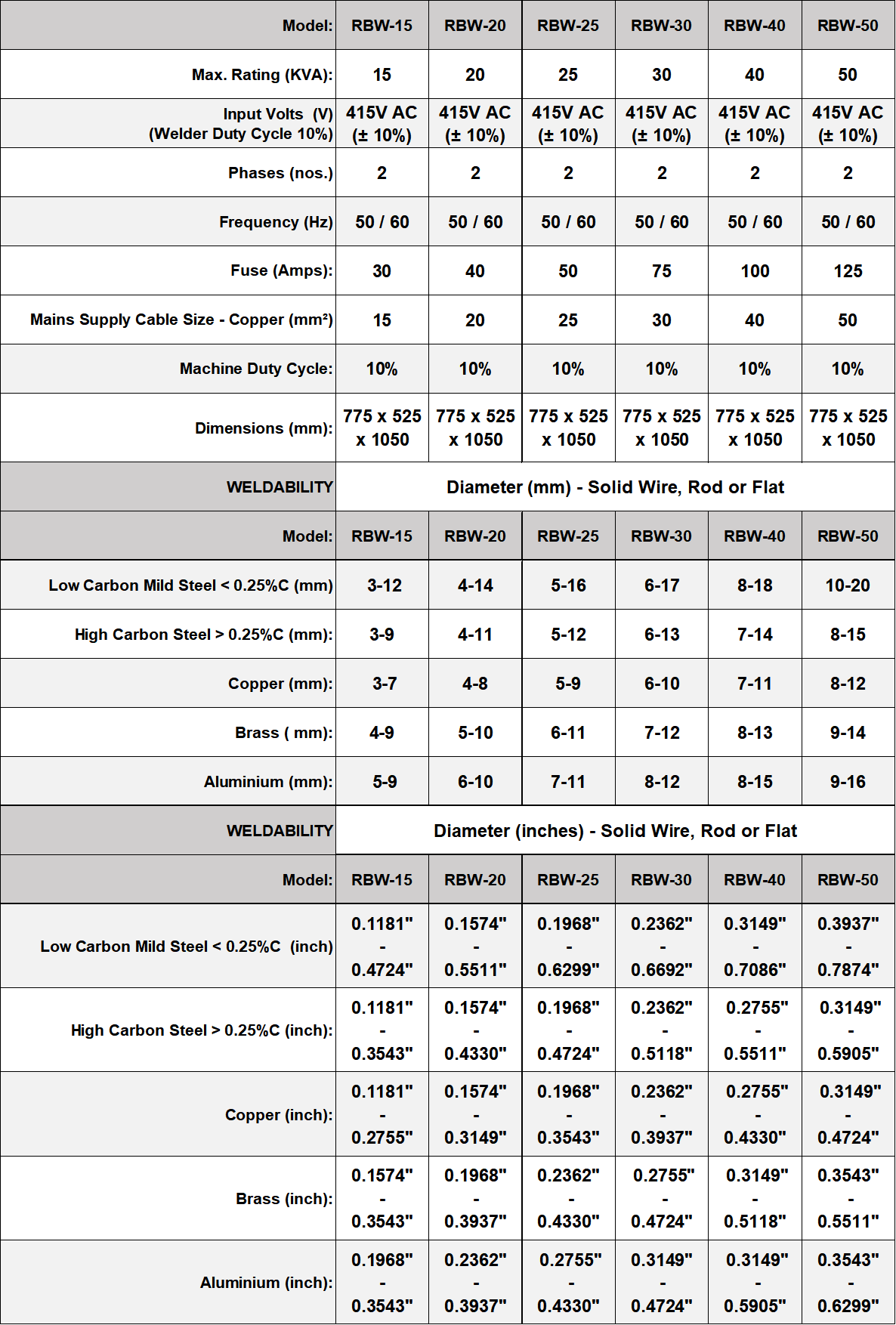
***Duty Cycle can be higher upto 50% with water cooling active on Welding Jaws and the transformer secondary coils.
Product Finder - Diameter of the Solid Wire or Rod (mm):
Weldability - Cross-Sectional Area of the Solid Wire, Rod or Flat (mm²):
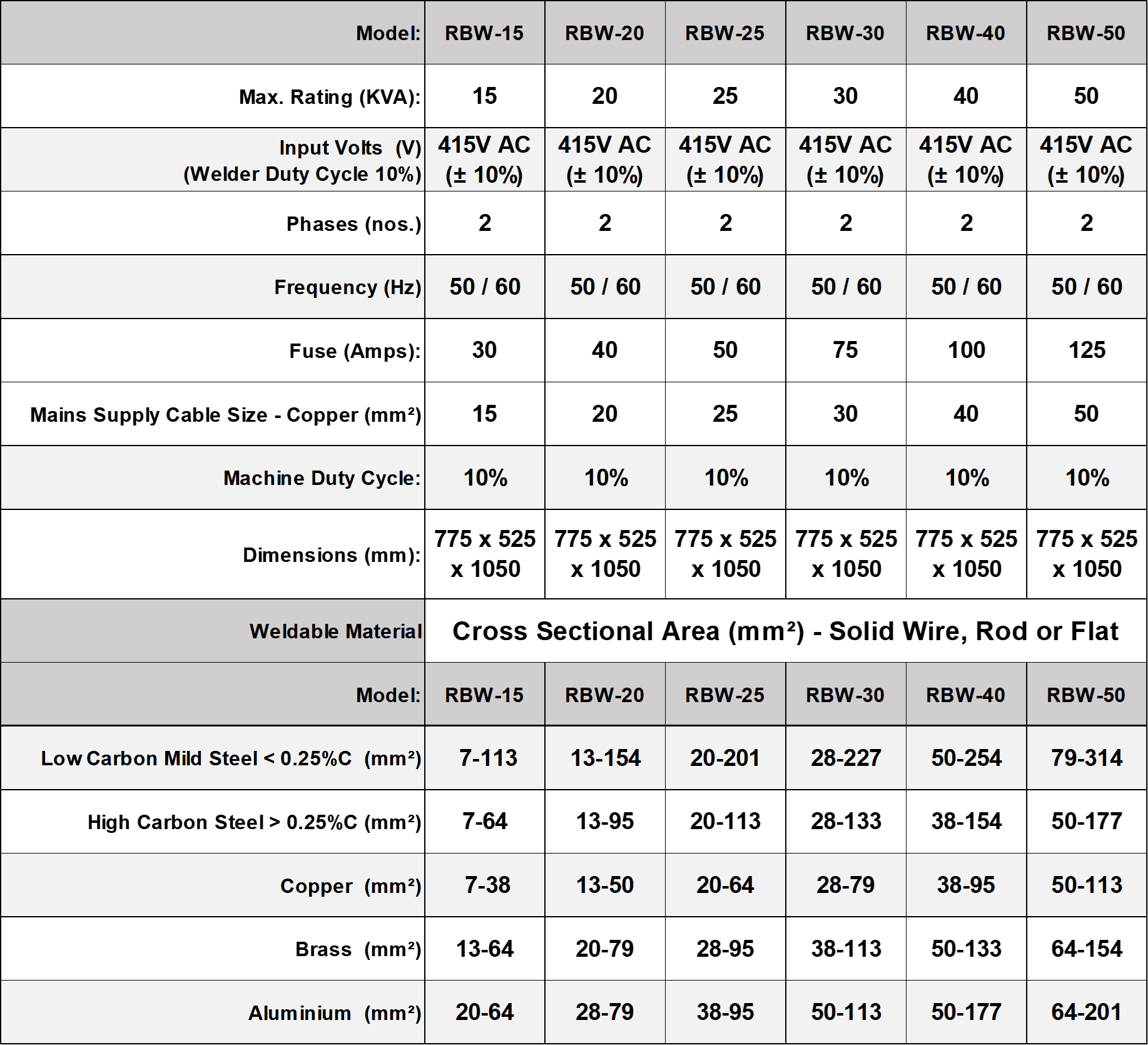
***Duty Cycle can be higher upto 50% with water cooling active on Welding Jaws and the transformer secondary coils.
Product Finder - Cross-Sectional Area of the Solid Wire or Rod (mm²):
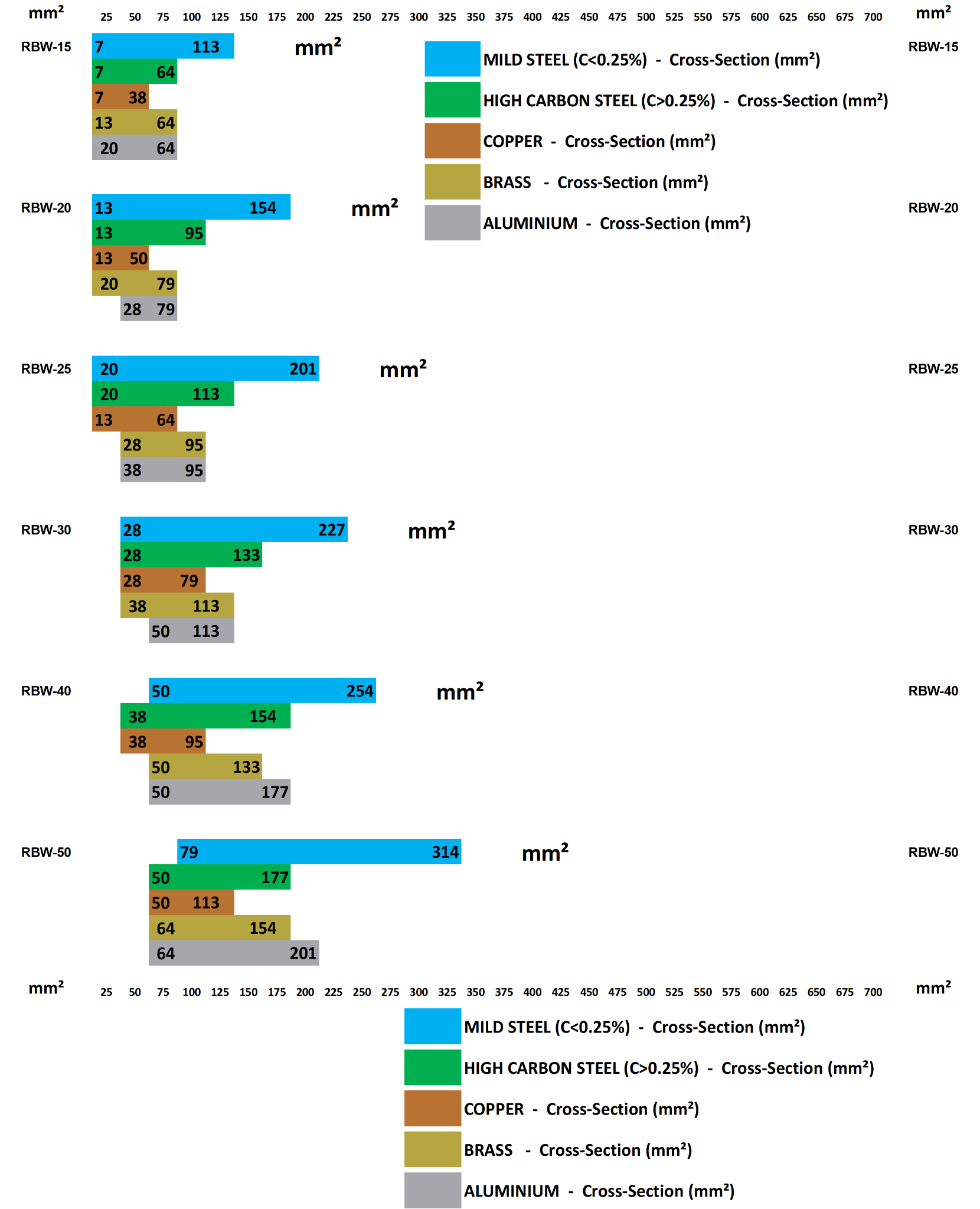
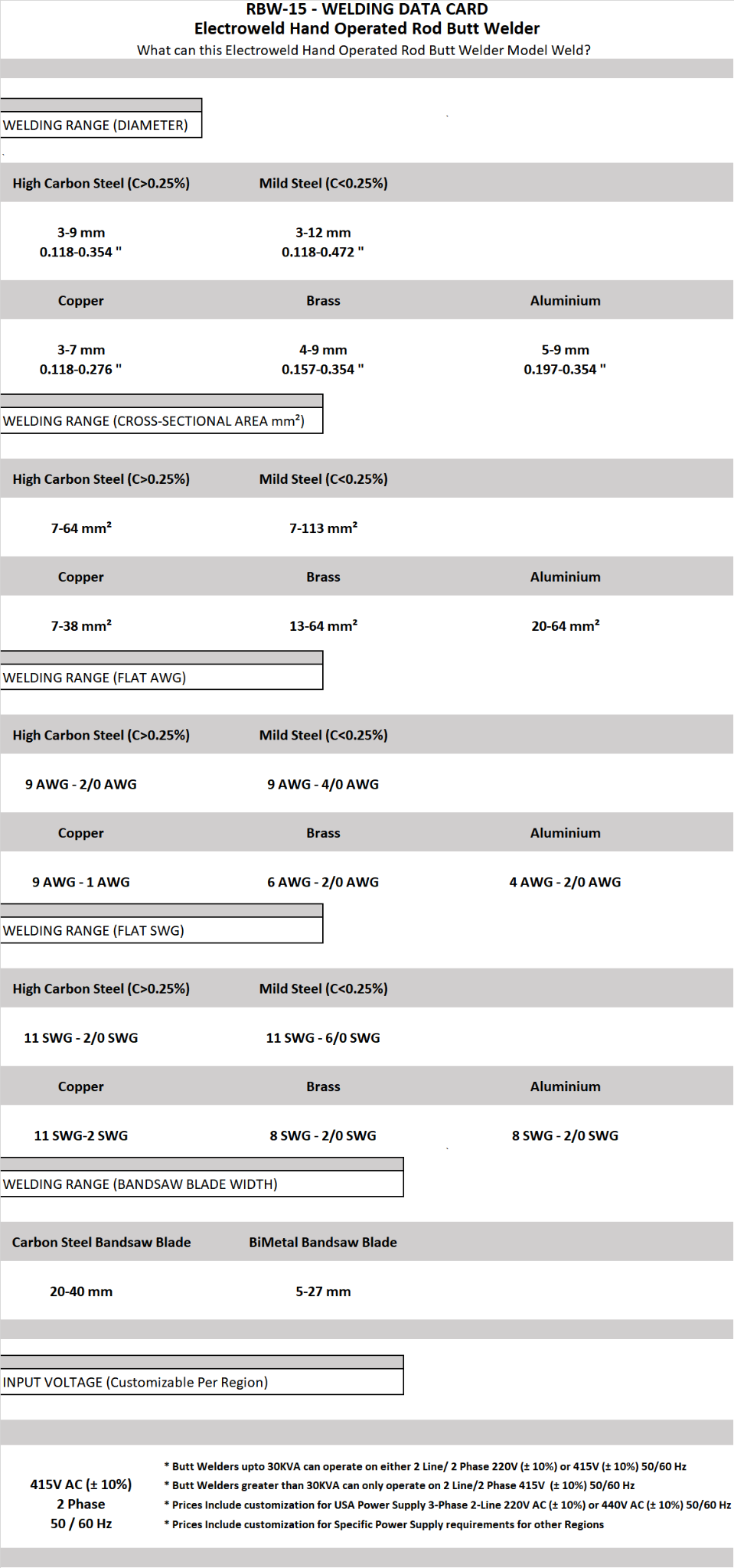
Expanded Specifications Table :
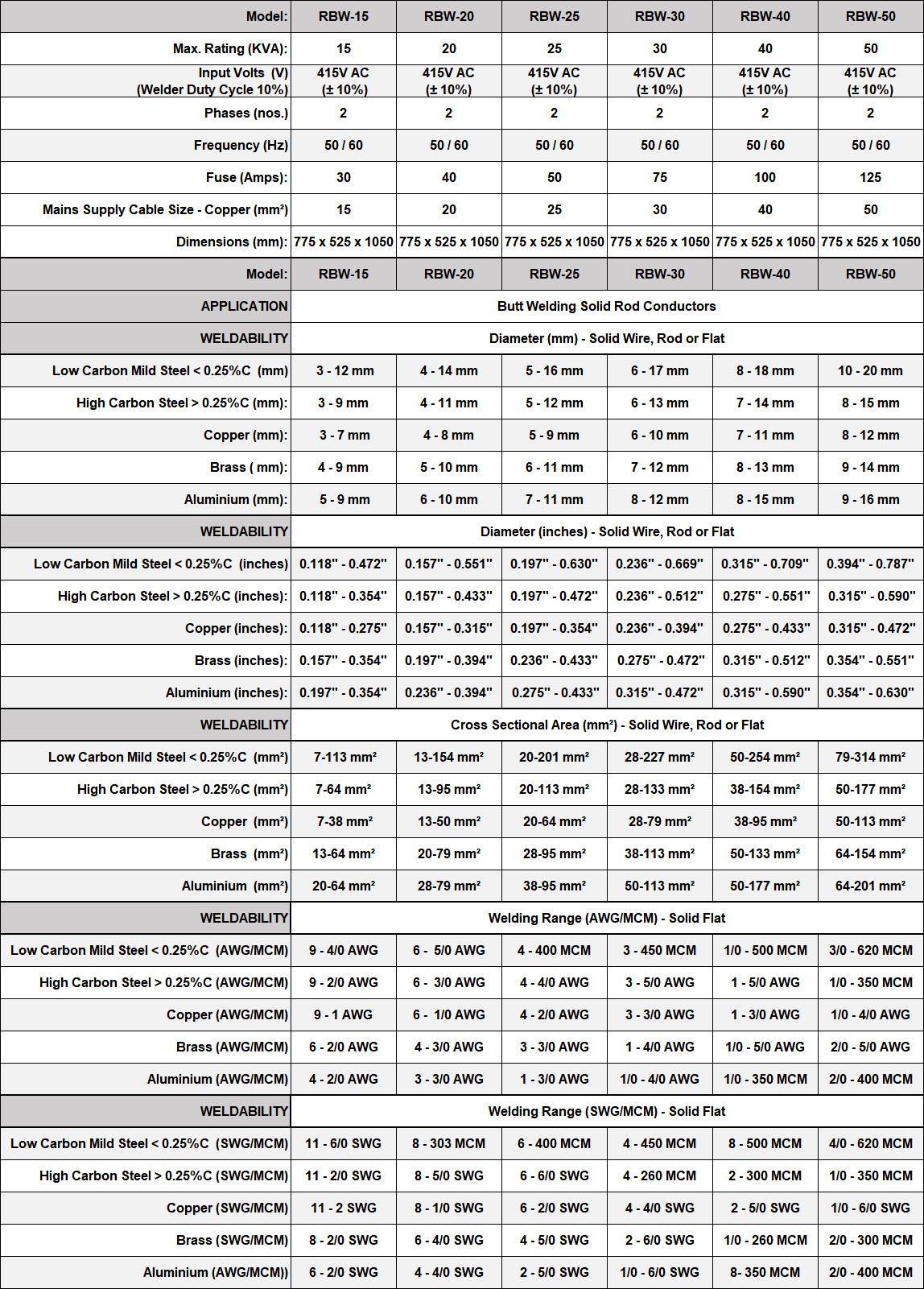
Optional Functionality
***Weldability - Flat Metal - All Electroweld Wire and Rod Butt Welders can weld Flat Metal jobs when customized with a flat jaw assembly instead of the standard jaws with grooves for wires and rods. For weldability ranges please contact us with the material and cross-section surface area.
****Weldability - Stranded Cables/Ropes/Cords Butt Welding using Glass Sleeves, Ceramic Sleeves or Carbon Sleeves which function as crucibles during the Stranded Cable Butt Welding Application- For weldability ranges please contact us with the material and cross-section surface area.
Operational Video #1 for the Electroweld Hand Operated Rod Butt Welder
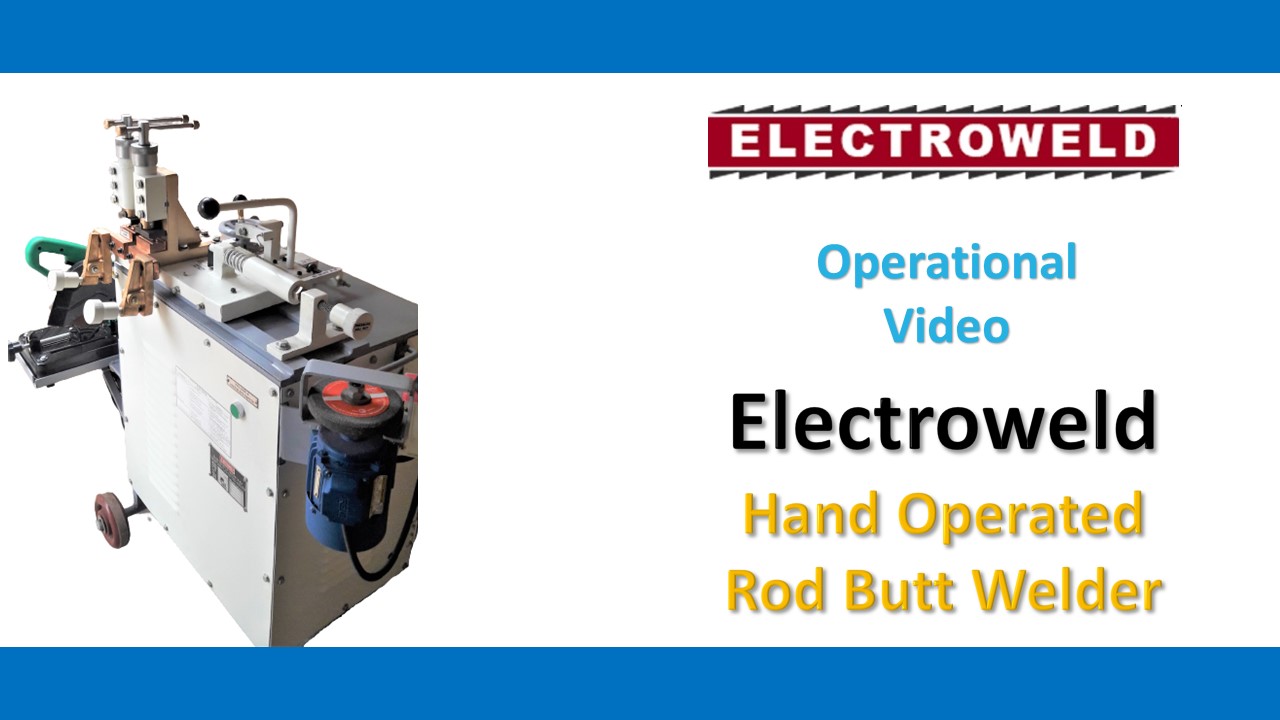
Electroweld Hand Operated Rod Butt Welder YouTube
Operational Video #2 for the Electroweld Hand Operated Rod Butt Welder
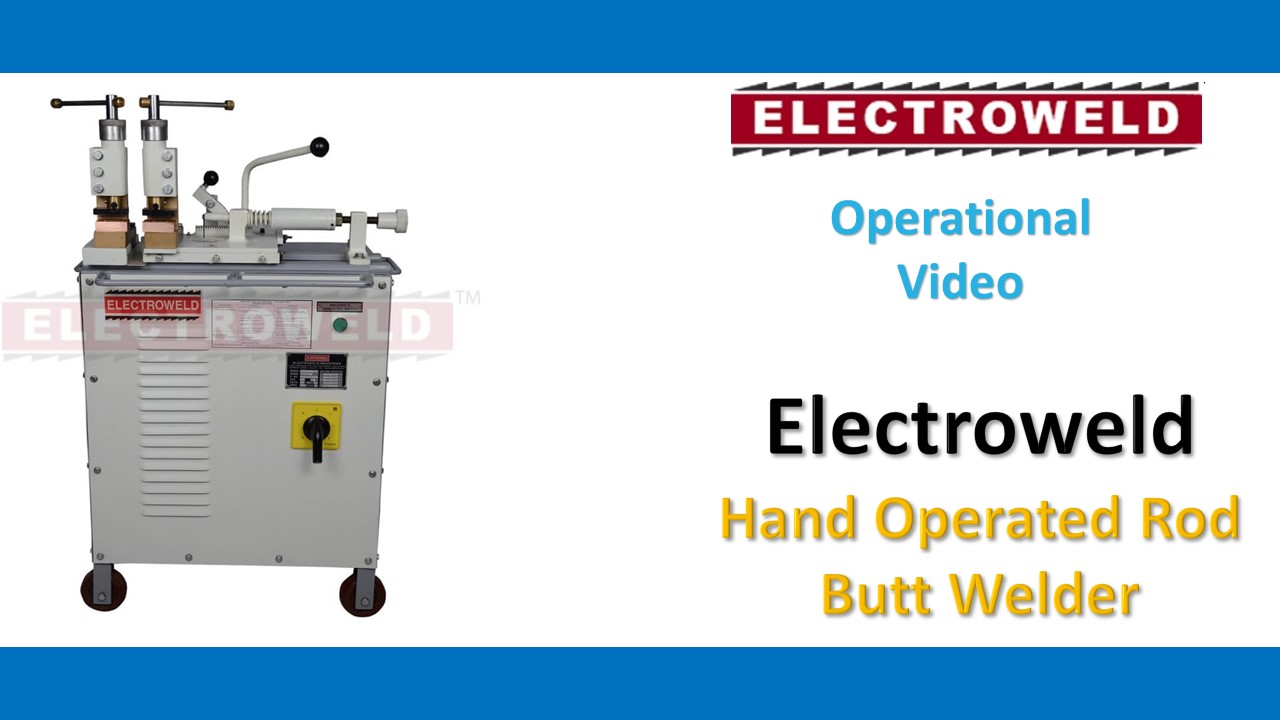
Electroweld Hand Operated Rod Butt Welder YouTube
Operational Video #3 for the Electroweld Hand Operated Rod Butt Welder
Electroweld Hand Operated Rod Butt Welder YouTube
Operational Video #4 for the Electroweld Hand Operated Rod Butt Welder
Electroweld Hand Operated Rod Butt Welder YouTube
Operational Video #5 for the Electroweld Foot Pedal Operated Rod Butt Welder
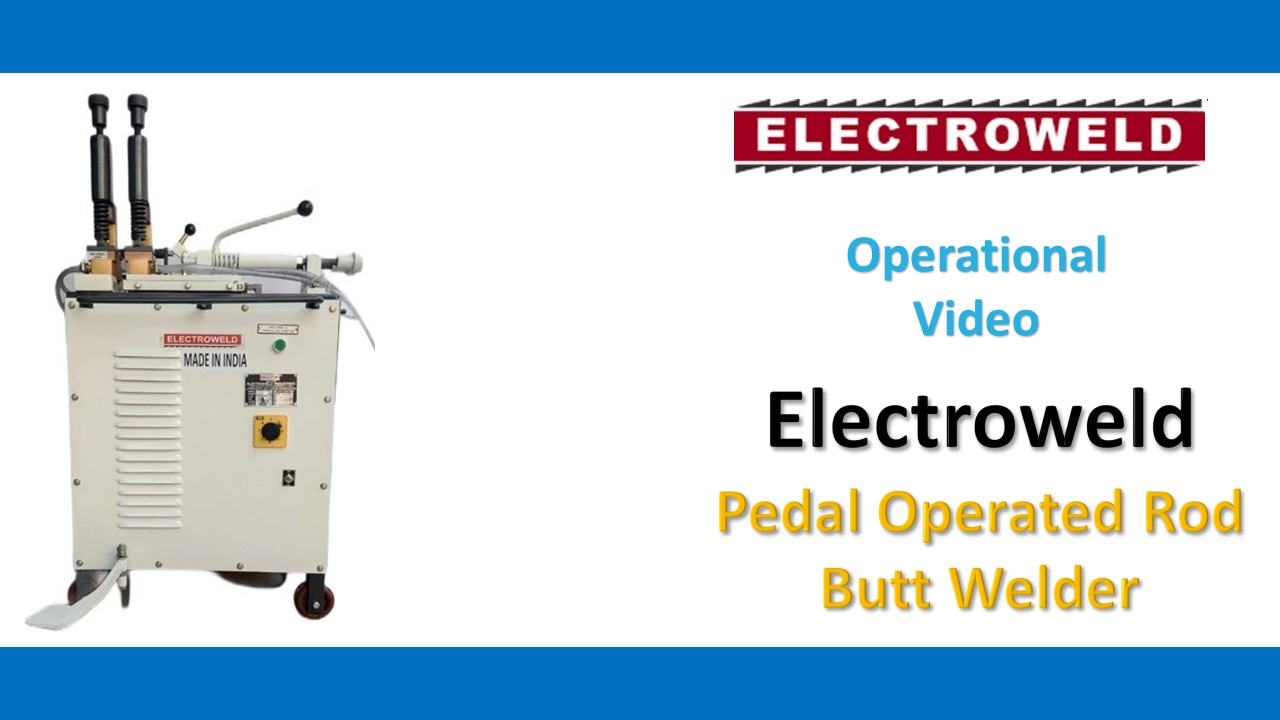
Electroweld Hand Operated Rod Butt Welder YouTube
What is Butt-Welding or Upset Welding?
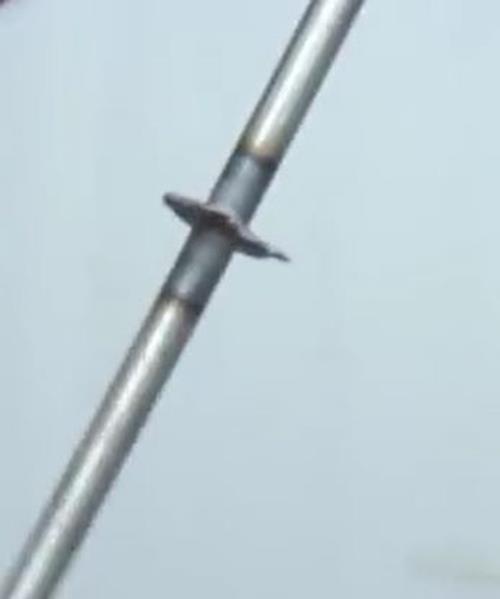
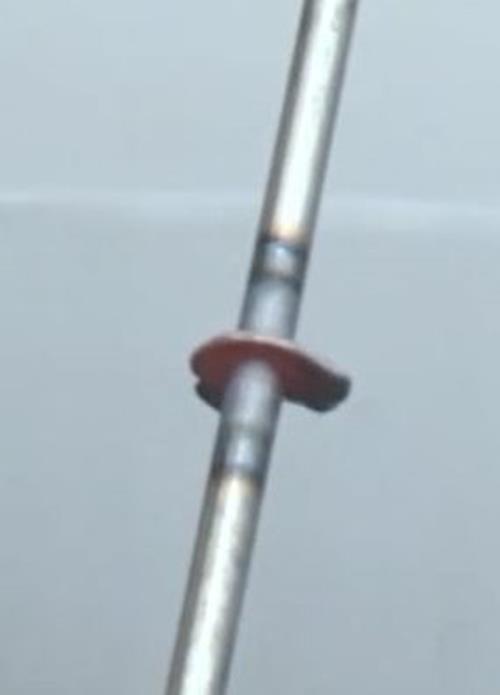
Butt-welding is a technique where two metal ends are connected with no overlap, forming a near seamless merger. To do so, the two ends are heated by passing an electric current through the weld interface. The interface causes heating due to resistance to the current. Heating continues until the metal reaches a plastic-like state. The ends (or butts) are then pressed together, where they form a knot or upset. The knot or upset is then ground down to a smooth finish. This technique is great for creating closed-loop steel rings or welding rods. Butt-welding is sometimes used interchangeably with Upset Welding. As we can see both of them are the exact same process with just a difference in the name.
Annealing-Post Weld Heat Treatment (PWHT):
Heat-treatment post welding involves, changing the properties of metals such as carbon steel or alloy steel by processes involving heating. It is used to harden, soften, or modify other properties of materials that have different crystal structures at low and high temperatures. The type of transformation depends on the temperature that the material is heated to, how fast it is heated, how long it is kept heated, what temperature it is first cooled to, and how fast it is cooled. For example, quenching hardens steel by heating it to high temperatures and then quickly immersing it in room temperature oil, water, or salt brine to prevent carbon atoms from moving through the crystal structure and forming carbides, which soften the metal. The two main approaches to softening a metal (to restore its ductility) are annealing, in which its temperature is slowly raised, held for some time, and slowly cooled, and tempering, in which it is slowly heated in an oil bath and held for some hours.Heat treatment following welding may be carried out for one or more of three fundamental reasons:
-To achieve dimensional stability in order to maintain tolerances during machining operations.
-To produce specific metallurgical structures in order to achieve the required mechanical properties.
-To reduce the risk of in-service problems such as stress corrosion or brittle fracture by reducing the residual stress in the welded component.
What is Annealing:
Annealing is a heat treatment process which alters the microstructure of a material to change its mechanical or electrical properties. Typically, in steels, annealing is used to reduce hardness, increase ductility and help eliminate internal stresses. This consists of heating a metal to a high temperature, where recrystallisation and/or a phase transformation take place, and then cooling slowly. This is often carried out to soften the metal after it has been hardened, for example by cold working; a full anneal giving the very softest of microstructures. It also results in a reduction in both the yield and the tensile strength and, in the case of ferritic steels, usually a reduction in toughness.One of the main applications of annealing is reversing the effects of work hardening. Besides steels, other metals may also benefit from annealing such as copper, aluminium and brass. For steels, subcritical annealing takes place at 540°C - 640°C (1000°F – 1200°F), so there is no crystal structure change. Intermediate annealing is carried out at 640°C - 760°C (1200°F – 1400°F), so there is some transformation to austenite and full annealing involves completely austenitizing the work at 815°C - 925°C (1500°F – 1700°F).
Why is Stress Relief required post-welding:
Welding involves the deposition of molten metal between two essentially cold parent metal faces. As the joint cools the weld metal contracts but is restrained by the cold metal on either side; the residual stress in the joint therefore increases as the temperature falls. To reduce this high level of residual stress, the component is reheated to a sufficiently high temperature. As the temperature is increased the proof strength falls, allowing deformation to occur and residual stress to decrease until an acceptable level is reached. The component would be held at this temperature (soaked) for a period of time until a stable condition is reached and then cooled back to room temperature. The residual stress remaining in the joint is equal to the proof strength at the soak temperature.
How does Stress Relief work via Post Weld Heat Treatment?
Stress relieving is a technique to remove or reduce the internal stresses in a metal. These stresses may be caused by a number of reasons, ranging from cold working to non-uniform cooling after forging. Stress relieving is usually accomplished by heating a metal below the lower critical temperature and then cooling uniformly. It relies upon the fact that, as the temperature of the metal is raised, the yield strength decreases, allowing the residual stresses to be redistributed by creep of the weld and parent metal. The high residual stresses locked into a welded joint may cause deformation outside acceptable dimensions to occur when the item is machined or when it enters service. High residual stresses in carbon and low alloy steels can increase the risk of brittle fracture by providing a driving force for crack propagation.
Listed price includes supplier paid shipping via CIF – Cost, insurance, and freight (named port of destination).
Any additional brokerage, customs, and duty fees associated with international shipments are the customer's responsibility and are not included
All return shipments including international return shipments would be at the cost of the buyer
We accept Paypal
The Warranty Information for ELECTROWELD INDUSTRIES products is available HERE
The TERMS & CONDITIONS for ELECTROWELD INDUSTRIES products is available HERE
Standard Incoterms Information on included shipping to destination port via CIF (Cost, insurance, and freight) is available HERE
- The machines will be shipped 2-3 weeks after clearance of payment.
- Shipping times may vary depending on any custom modifications and complexity of the request.
- Shipping times may vary depending on larger than 2 Qty of machines ordered in a shipment
- Additional spares and consumables can be ordered separately to be shipped together with the machines
- Standard one year warranty with the faulty machine shipped to factory and back to buyer after repairs both at buyers expense
- Cost, insurance, and freight (CIF) is an expense paid by a seller to cover the costs, insurance, and freight of a buyer's order while it is in transit. The goods are exported to a port named in the sales contract. Until the goods are fully loaded onto a transport ship, the seller bears the costs of any loss or damage to the product. Further, if the product requires additional customs duties, export paperwork, or inspections or rerouting, the seller must cover these expenses. Once the freight loads, the buyer becomes responsible for all other costs.
Absolutely no complaints!
This product is a superb tool. It's a fantastic value for the money.
- Brandon U..
Absolutely no complaints!
This product is a fantastic tool that delivers great results.
- Virginia W..
Absolutely no complaints!
The build is robust and the performance is flawless.
- Promise K..
Discover more great products from our collection.


Copyright 2026 © mappa-mercia.org


